
The 30-year fixed mortgage rate hit 6% on January 9, marking a three-year low following a surprise $200 billion government purchase of mortgage-backed securities aimed at lowering borrowing costs for homebuyers.
The obvious question: what does history tell us about where housing activity could go from here?
What the Long-Term Chart Shows
A long-term comparison of Existing Home Sales versus the 30-Year Fixed Mortgage Rate reveals a relationship that is anything but linear.
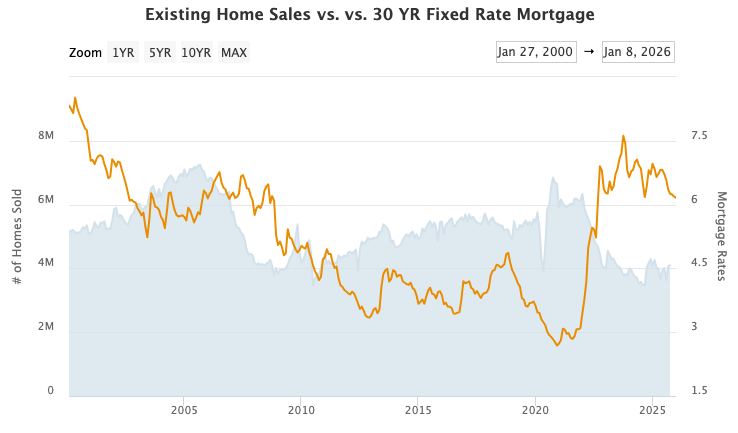
Source: 30-year based on Mortgage News Daily
Some may recall the early 2000s, when mortgage rates fell sharply from roughly 8% to the low-5% range. This fueled annual home sales by nearly 1 million units during that period.
Fast forward to November 2008, the last time the monthly average 30-year mortgage rate sat near 6%. From that point forward, rates remained below 6% until September 2022. During this extended low-rate environment, existing home sales climbed from approximately 4.1 million annually to a peak of 6.9 million in October 2020.
Point being— existing home sales have remained at or below 4.5 million since late 2022 vs. pre-pandemic and what experts feel is a more normal range of 5-6 million units per year.
Why This Rate Move Matters Now
While it remains to be seen whether the government’s initial purchase of mortgage bonds will have a lasting impact on rates, it’s difficult to ignore the recent move lower. Mortgage rates have fallen from the low-7% range to 6%, a 125-basis-point swing over the last 12-months.
On a $500,000 mortgage, the difference between 7.25% and 6% equates to roughly a 12% reduction in monthly principal and interest payments.
Now layer in:
- Nominal wage growth of ~3.5% in 2025
- Modest home price appreciation
Combined, buyers entering 2026 have roughly a 10% improvement in affordability compared to a year ago.
Is the Housing Market Finding Its Footing?
While this is admittedly “back-of-the-napkin” math, the direction is meaningful. After a cooling period in the back half of 2025, the housing market may be starting to find firmer ground.
We also see a clear policy signal: for better or worse, the government appears motivated to push mortgage rates lower. If wage growth holds in the low-to-mid single-digit range during 2026, rates continue to ease, and home values remain stable, existing home sales could steadily climb throughout the year.
Supporting this view, a recent CNBC Housing Market Survey found that nearly two-thirds of real estate agents expect sales to improve in Q1 2026, signaling a shift from market anxiety toward cautious optimism.
Buy, Sell, or Wait?
So, is now a good time to buy or sell?
The honest answer: every market is unique.
Our preference would be for a steady, balanced housing market over the next several years—one that allows incomes to catch up after the dramatic swings in rates and inflation that have challenged buyers since 2020.
Our bull case:
- Continued downward pressure on mortgage rates
- Mid-single-digit wage growth
- Home prices holding steady or rising in the low single digits
This environment would support healthier, more sustainable housing activity.
The risk? If rates are pushed too low and wage growth and inflation accelerate again, home prices could surge—once again pushing affordability out of reach for many buyers, especially first time buyers.
Bottom Line
Lower rates are helpful, but they are not a silver bullet. The housing market’s next chapter will depend on the balance between rates, wages, employment, and price stability. If those variables stay aligned, 2026 could mark a return to gradual, sustainable growth rather than another boom-and-bust cycle.