North Point Redevelopment: What Alpharetta, Milton & Roswell Homeowners Need to Know
The proposed North Point transformation could bring major new entertainment, dining, parks and housing to North Fulton— but what could it mean for the people who already live here?
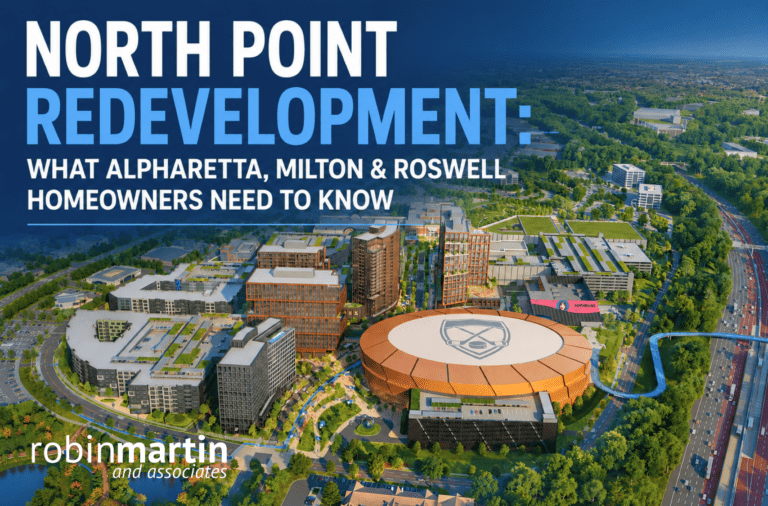
If you own a home or are considering buying or selling in Alpharetta, Milton, Roswell or the surrounding North Fulton area, you have probably heard about the proposed redevelopment of North Point Mall.
The nearly 100-acre site could be transformed into a major sports and entertainment district centered around a proposed 20,000-seat arena designed to accommodate a future NHL team. The plan also calls for restaurants and retail, hotels, office space, residential units, a music and performing arts venue, a community ice rink, and more than 16 acres of parks, plazas and multi-use trails.
But what could all of this actually mean for local homeowners?
The answer isn’t as simple as “home values will go up.” A development of this scale could bring significant benefits to the area, but it could also create challenges— particularly for people who live close to North Point.
And importantly, the project is still a proposal. As of August 24, 2026, the Alpharetta Planning Commission has recommended approval, but the Alpharetta City Council is scheduled to consider the rezoning request on the evening of August 24. The NHL itself has not awarded Atlanta an expansion franchise, and much of the proposed development is contingent on that happening.
The Potential Upside for Homeowners
1. Greater Demand for Nearby Homes
Major investments in infrastructure, entertainment, dining and employment can make an area more attractive to prospective residents.
The proposed North Point district would create a destination with restaurants, retail, hotels, offices, entertainment venues, parks and potentially professional sports— all within one walkable district. That could increase the appeal of nearby neighborhoods to buyers who value convenient access to amenities.
However, it is important to distinguish potential increased demand from a guaranteed increase in home values. Real estate values are influenced by many factors, including interest rates, inventory, schools, neighborhood characteristics and the overall economy.
For homeowners, the redevelopment could ultimately become another positive amenity associated with living in North Fulton, but the market will determine how much that translates into property value.
2. New Amenities and a More Walkable Destination
One of the biggest changes would be the transformation of the existing mall property from a traditional enclosed shopping center into a mixed-use district.
The current proposal includes more than 16 acres of publicly accessible parks, plazas and multi-use trails, along with restaurants, retail, entertainment and residential development.
For nearby homeowners, that could mean access to a wider range of dining, entertainment and recreational options without having to travel as far.
The development is also designed around a more pedestrian-oriented street network, which could change how residents and visitors experience the North Point area.
3. Potential Economic Benefits for North Fulton
The project is intended to generate new jobs, expand the local tax base and create a year-round destination rather than relying on a traditional enclosed mall as its primary attraction. The proposal includes approximately 750,000 square feet of office space, hundreds of hotel rooms, retail and dining, and 1,385 proposed for-rent residential units.
If successfully developed, those investments could strengthen the North Point corridor and contribute to the area’s long-term economic vitality.
Again, though, these are potential benefits—not guarantees. The ultimate economic impact will depend on what is actually built, how quickly it is developed, and whether the project succeeds in attracting the businesses, visitors and professional sports franchise envisioned by its developers.
The Potential Challenges for Homeowners
1. Traffic and Increased Activity
This is probably the most immediate concern for people who already live in the North Point area.
A 20,000-seat arena, music venue, restaurants, hotels, offices and other businesses would bring substantially more activity to a corridor that already experiences congestion.
Game days and major concerts could create particularly noticeable traffic around North Point Parkway, Haynes Bridge Road and GA-400.
For homeowners who value the convenience of the area but also enjoy its relatively suburban character, this could be one of the biggest trade-offs.
At the same time, the proposed development includes plans for pedestrian and transit connections and infrastructure improvements intended to help accommodate the additional activity. Exactly how well those improvements work will become clearer as the project progresses.
2. Years of Construction and Change
If approved and ultimately built, transforming nearly 100 acres from a traditional shopping mall into a mixed-use district will be a significant undertaking.
Residents near the site should expect construction activity, changes to traffic patterns and ongoing disruption during the redevelopment process.
The exact construction schedule and sequencing are not yet certain, however, so it would be premature to characterize the project as a specific number of years of construction.
3. More Competition for Housing
The proposed district includes 1,385 for-rent residential units.
For homeowners, the impact of that additional housing is more complicated than simply assuming it will either help or hurt property values.
More housing can add population and demand to the area while also increasing the overall supply of available residences. The effect on surrounding single-family neighborhoods will depend on who ultimately lives in those units, the type of housing constructed, and how the development affects demand throughout North Fulton.
For buyers, however, the redevelopment could eventually provide another option for people who want to live close to restaurants, entertainment, offices and recreational amenities.
What Could It Mean for Your Home’s Value?
This is the question we are hearing most often— and there isn’t a responsible way to promise that North Point will cause surrounding home values to rise by a particular amount.
There are good reasons to believe a successful redevelopment could be a positive factor for nearby neighborhoods. Major amenities, entertainment, employment and improved public spaces can contribute to an area’s desirability.
But proximity isn’t automatically a benefit for every property.
A homeowner who is a short walk from a restaurant district may see the new amenities as a major advantage. Someone whose daily commute takes them directly through event traffic may have a very different perspective.
Distance from the development, neighborhood location, traffic patterns, property type and buyer preferences will all matter.
That’s why we would look at the North Point redevelopment as one factor in a much larger real estate equation, rather than assuming it will automatically create a “North Point premium.”
The Homeowner’s Matrix: Pros & Cons
For Sellers & Current Owners
For Future & Current Buyers
What Should Homeowners Do Now?
For most homeowners, there is no reason to make a major real estate decision based solely on the North Point proposal.
Instead, consider how the redevelopment fits into your specific property, neighborhood and plans.
If you’re thinking about selling, we can help you evaluate how buyers are responding to the North Point area today—and how the proposed redevelopment could factor into your property’s marketing strategy.
If you’re considering buying, we can help you understand which neighborhoods may benefit from the new amenities while also helping you evaluate potential traffic, construction and other trade-offs.
And if you’re simply wondering what the redevelopment could mean for your home, we’re happy to talk through it with you.
North Point is a major change for North Fulton, but exactly what it means for your home will depend on where you live, what ultimately gets built and how the market responds.
If you have questions about how the North Point redevelopment could affect your home or your next move, give us a call at (404) 919-5454 or email inquiry@robinmartinassoc.com.