
Home sales are slowing, inventory is growing, and price reductions are becoming increasingly common across North Atlanta. The market shift we’ve been discussing for more than a year is now showing up more clearly in the numbers.
A Market That Has Clearly Shifted Toward Buyers
The Metro Atlanta housing market continues to move toward a more buyer-friendly, price-sensitive environment. September housing data for the 29-county Atlanta Metropolitan Statistical Area (MSA) tells the story:
4,947 homes sold, a 15% decline from September 2025.
Active listings increased 6%, giving buyers more choices.
Median sales prices remained essentially flat compared to a year ago.
Pending and under-contract activity declined 23%, suggesting further weakness in closed sales could lie ahead.
While home prices have generally held up better than sales volume, the balance of negotiating power has shifted. Buyers are becoming more selective, homes are taking longer to sell, and sellers are increasingly having to adjust their expectations.
We’ve Been Watching This Trend Develop for Some Time
As readers of our newsletters and weekly market updates may recall, we began highlighting signs of a softening housing market well over a year ago. Our observations weren’t based on speculation. They came from our firsthand experience in local markets, combined with a careful review of housing data, historical trends, and market activity.
At the time, these concerns weren’t always widely shared, and understandably so. Many homeowners still remember when their neighbor’s home sold in a weekend, received multiple offers, and closed well above asking price. Those experiences created expectations that have been difficult to shake. But real estate markets don’t stand still, and yesterday’s market conditions don’t necessarily reflect today’s reality. Now, in October 2026, the changes are becoming more apparent.
Drive through certain North Atlanta neighborhoods today, and you’ll see something that was relatively uncommon just a few years ago: numerous homes that have been on the market for months, accompanied by repeated price reductions.
A Closer Look at North Atlanta: Price Reductions Tell the Story
One example is the Centennial High School market, which includes portions of Alpharetta, Johns Creek, and Roswell. Currently, this market has:
168 homes actively listed for sale
More than 40% of listings with at least one price reduction
An average of 87 days on market
More than four out of every ten homes currently for sale have already needed at least one price adjustment. This doesn’t mean homes aren’t selling; they certainly are. However, it does mean that pricing, property condition, presentation, and marketing have become considerably more important. Sellers who continue to price based on what their neighbor received two or three years ago may find themselves making repeated adjustments to keep pace with the market.
Home Sales Are Approaching Levels Last Seen During the Housing Recovery
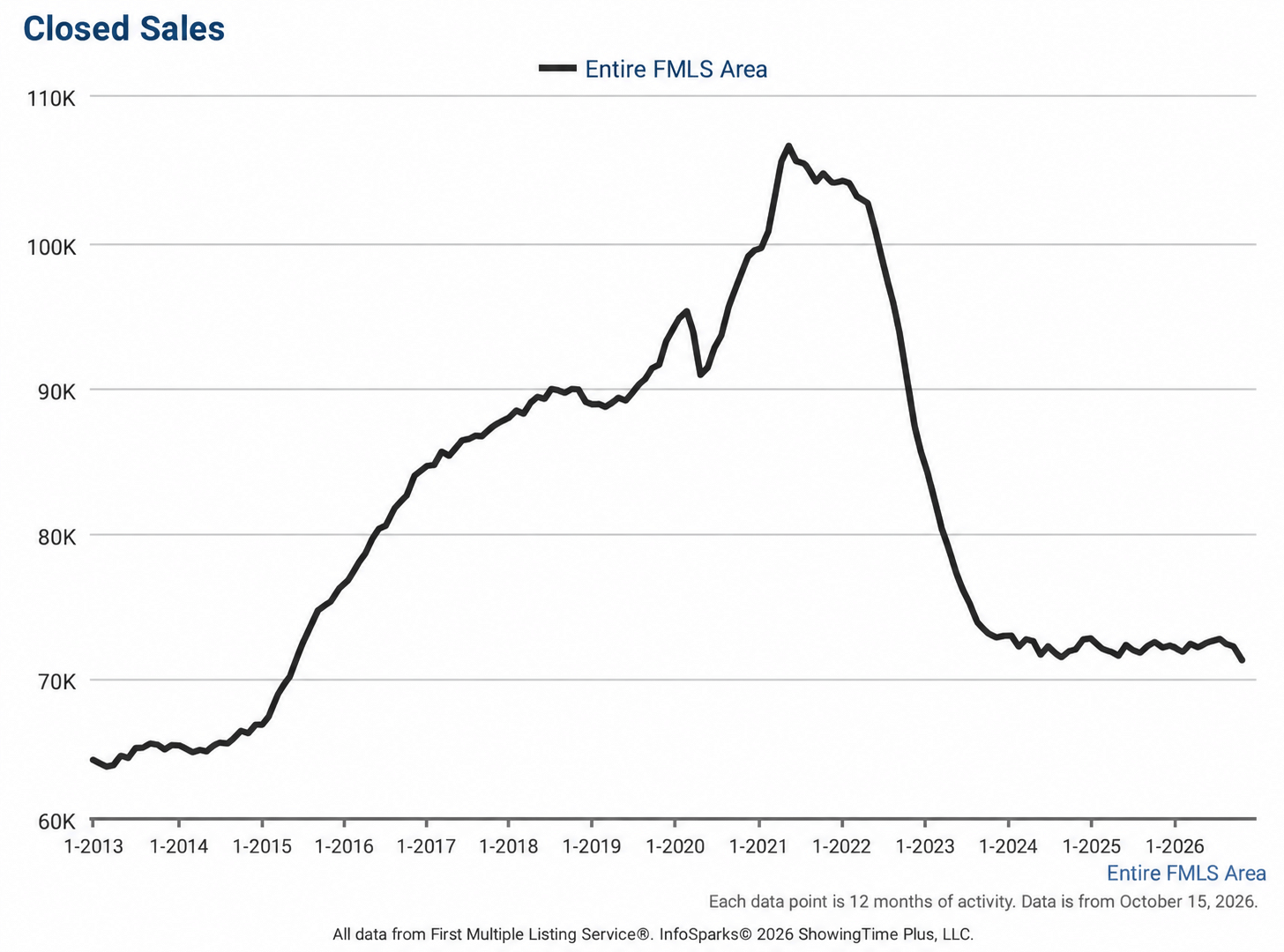
One revealing indicator is the total number of homes being sold across Metro Atlanta. Rather than looking at individual months, which can fluctuate significantly due to seasonality, we track home sales using a rolling 12-month total. This approach smooths out seasonal variations and provides a clearer picture of the overall direction of the market.
The chart highlights an interesting trend. From 2013 through approximately mid-2015, during the recovery following the 2008–2009 housing crisis, Metro Atlanta recorded fewer than 70,000 home sales annually on a rolling 12-month basis. Today, we’re approaching those levels once again.
Based on the current pace of closings and the decline in pending sales, we believe the rolling 12-month total could fall below 70,000 transactions over the next several months. That would represent a significant slowdown in transaction activity, even though home prices have not experienced anything resembling the collapse associated with the last housing crisis. It’s an important distinction: lower sales volume does not automatically mean a housing crash, but it does indicate a market in which buyers and sellers may have more difficulty reaching agreement on price.
How Are Alpharetta, Roswell, Johns Creek, and Milton Performing?
While the overall Metro Atlanta numbers are important, real estate is ultimately local. Some communities are experiencing more pressure than others. Here’s how September’s housing market compared with the same period last year:
| Market | September 2026 Year-Over-Year Changes |
|---|---|
| Alpharetta | Closed sales down 31%; average sales price down 4%; inventory up 3%; days on market up 36% to 49 days |
| Roswell | Closed sales down 21%; average sales price down 1%; inventory up 6%; days on market up 13% |
| Johns Creek | Inventory up 133%; closed sales down 3% |
| Milton | Inventory up 25%; closed sales down 35% |
The numbers reinforce an important point: Not every market is experiencing the slowdown in the same way. Johns Creek has seen a particularly significant increase in available inventory, while Alpharetta and Milton have experienced substantial declines in closed transactions. For homeowners considering selling, understanding these differences is critical. Even within the same city, market conditions can vary significantly by neighborhood, price range, school district, and property condition.
Mortgage Rates Continue to Complicate the Market
Mortgage rates remain a significant challenge for buyers and sellers alike. Higher borrowing costs reduce purchasing power and make homeownership less affordable, particularly for first-time buyers and those looking to move into a more expensive home. They also create a difficult decision for existing homeowners with mortgage rates in the 2%–4% range. Selling their current home may mean giving up an exceptionally low rate and taking on a substantially higher monthly payment.
Recent mortgage-rate increases have added another layer of uncertainty, contributing to weaker mortgage purchase application activity. Until affordability improves through some combination of lower mortgage rates, higher incomes, or more competitive home prices, transaction volume may remain under pressure.
What Does This Mean for Buyers and Sellers?
For sellers: The days of simply putting a home on the market and expecting multiple offers are largely behind us in many price ranges. Accurate pricing, professional photography, property preparation, and a comprehensive marketing strategy are more important than ever. Homes that are priced correctly and presented well can still attract strong interest. However, overpriced homes are increasingly sitting on the market, accumulating days on market and ultimately requiring price reductions.
For buyers: The market is offering opportunities that have been less common in recent years. More inventory means greater selection, additional time to evaluate properties, and increased negotiating leverage. Buyers may have opportunities to negotiate price reductions, closing cost contributions, repairs, or other favorable terms that were difficult to obtain during the peak seller’s market.
Our Outlook: A Market That Requires More Strategy
We don’t believe the current housing market should automatically be compared to the housing crisis of 2008–2009. Lending standards, homeowner equity, and other underlying conditions are considerably different. However, the slowdown in transaction volume is real, and the growing number of price reductions suggests sellers are increasingly adjusting to changing market conditions. We expect pricing pressure to remain a factor in certain neighborhoods and price ranges, particularly if mortgage rates stay elevated and inventory continues to outpace buyer demand.
For homeowners, the most important takeaway is simple: The market has changed, and your real estate strategy needs to change with it.
At Robin Martin & Associates, we closely monitor market activity across Roswell, Alpharetta, Johns Creek, Milton, and the surrounding North Atlanta communities. Our goal isn’t simply to tell clients what they want to hear. It’s to provide an accurate picture of the market so they can make informed decisions, whether they’re buying, selling, or simply planning for the future. If you’re curious about how these trends are affecting your neighborhood or your home’s current value, we’re always happy to share what we’re seeing.
Robin Martin & Associates